Tiffany


'Painting' with the Tiffany technique


Windows made using this technique are lighter than stained-glass windows, but Tiffany work is not weather-resistant and therefore cannot be placed outdoors.

With the Tiffany technique, you can create not only windows, but also window hangings, freestanding objects, and jewelry. Because copper foil is used here instead of lead, you can work more finely, allowing you to, as it were, paint with glass. So, that is not mandatory; it is an option.
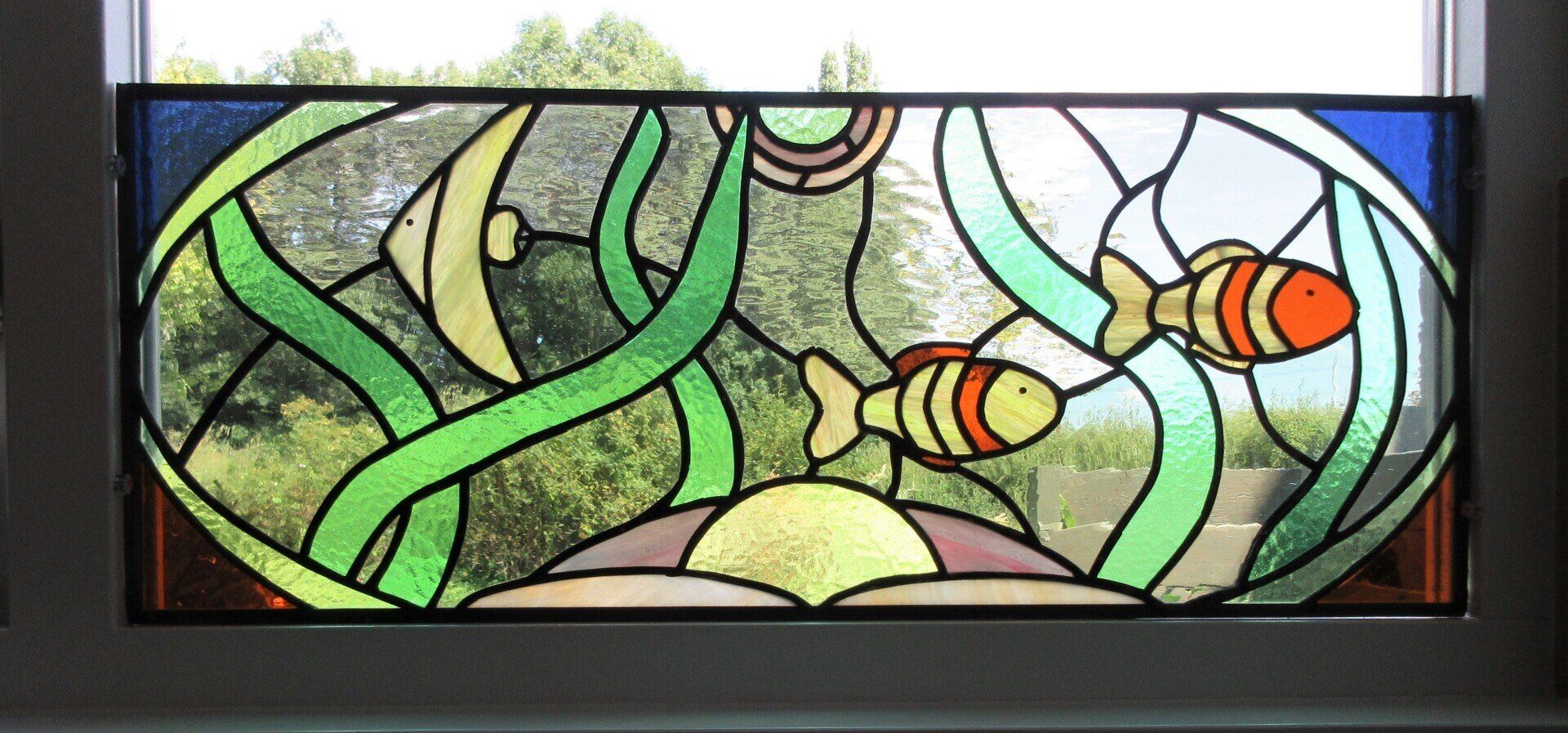

Interior windows

Interior windows (or actually: secondary windows) can be made using the Tiffany technique just as well as stained glass; it simply depends on what you find most beautiful.

Because copper foil is used here, smaller pieces can be used, as well as more complex shapes.

Exterior windows

Exterior windows can also be made using the Tiffany technique, such as the windows in the photo on the right. However, since Tiffany work is not weather-resistant, the windows must be fitted with double glazing in that case.

Tiffany features:

  • Glass in tinfoil

    The glass is wrapped individually with copper foil, a very thin foil with an adhesive side. All wrapped pieces are placed against each other, and all the remaining visible copper foil is soldered.

  • Tiffany's construction

    In a nutshell: - designing - calculating dimensions if necessary - cutting glass - grinding all glass pieces - wrapping glass with copper foil - folding and smoothing copper foil - greasing copper foil - soldering copper foil - turning work over - greasing copper foil - soldering copper foil - soldering sides - polishing - optionally patinating the copper foil on both sides (chemically aging the foil), polishing again - optionally attaching hooks to the work

  • Weatherproof

    Because the copper foil is adhered to the glass like a kind of sticker, Tiffany work is not weather-resistant.

  • Broken Tiffany glass

    With Tiffany works, if something is wrong, it is usually a piece of glass that is broken. In principle, this can be replaced, but it is not simple. If copper foil is loose, that can also be replaced. The only question then is how much foil is loose, and therefore to what extent the work needs to be disassembled.

  • New work can be made 'old' immediately.

    Freshly soldered copper foil shines like a mirror and is silver-colored. Over time, it oxidizes and becomes increasingly dark. If you do not want to wait years, it can be chemically aged and colored immediately.

  • Sustainable or not?

    In the case of Tiffany glass, too, this question cannot simply be answered with a 'yes' or 'no'. To start with 'no': quite a few raw materials and chemicals are needed to make a Tiffany piece. Moreover, copper is a heavy metal that cannot simply be thrown away with the regular trash. On the other hand, you can also choose 'yes': if you consider that Tiffany work lasts for years and can be restored afterwards, then you are certainly not contributing to the throwaway society. Furthermore, an object can always be completely disassembled, and with some creativity, a new design can be made from the glass. Environmentally friendly measures I take: instead of cutting oil and cleaning agents with propellants, I use green soap, and all electricity used here is generated by means of solar panels. Glass scraps are reused as much as possible.